5 key business benefits of IT service mapping

When a business service goes down, most IT teams start the same way: digging through monitoring alerts, pulling in whoever knows the affected system, and guessing which infrastructure component broke what. That reactive cycle costs hours. IT service mapping fixes the problem at the source. Documenting every dependency between your infrastructure and the services it supports, it gives your team a clear, current map to act on, whether you are managing an incident, assessing a vulnerability, or planning a change.
What is IT service mapping, and how does it work?
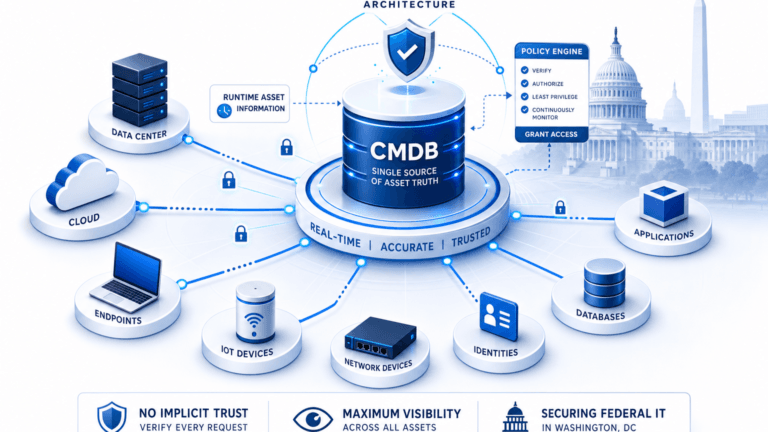
IT service mapping is the practice of documenting and visualizing how infrastructure components (servers, applications, databases, and networks) connect to and support specific business services. It gives your team a structured view of service dependencies, which means faster incident response, more accurate change risk assessment, and better visibility into what each service costs. It is built on top of your CMDB and sits at the core of day-to-day ITSM.
To get value from it, you first need to think in terms of services rather than infrastructure. Most teams manage servers, software, and network devices. Service mapping asks a different question: how do those components combine to deliver something with measurable value to a business unit or a customer? A service can be anything from payroll processing to inventory management to a customer-facing web application. Each one depends on a specific mix of hardware, software, and people. Service mapping documents those combinations and keeps them current as your infrastructure changes.
Service management is the set of practices you use to deliver and support those services. Most organizations run into the same obstacles: data quality, hybrid infrastructure complexity, and organizational buy-in. A structured approach to service mapping implementation (covering discovery scope, map validation, and ongoing maintenance) is what separates a one-time project from a durable operational capability.
How the mapping itself works. IT service mapping happens in two stages. First, you define services: which applications, websites, and infrastructure components make up each one, entered manually, through spreadsheet import, or through integrations with tools like LeanIX. Then, IT discovery runs high-frequency discovery cycles to find the configuration items (CIs) and map their relationships. The output is a visual service map that shows every dependency in a service’s delivery chain. Virima’s ViVID™ service maps render those dependencies in a dynamic visual interface, so you can trace from a single failed component to every affected service in seconds.
A service map is only as accurate as the CMDB beneath it, so discovery and CMDB health are the foundation, not an afterthought. For a practical starting point, the guide on CMDB best practices covers the steps to get records accurate enough to support reliable service maps.
What a service portfolio represents
A service portfolio is your organization’s investment in a defined set of services across their full lifecycle. It balances three categories: the service catalog (services available now or soon, funded and supported operationally), the service pipeline (services in development, representing investment in growth), and retired services (no longer offered or funded, freeing assets and staff for redeployment). Service maps support portfolio management by showing what infrastructure each service depends on, what it costs to maintain, and what breaks when components change or are removed.
The role of configuration management and the CMDB
Configuration management is the discipline that makes IT service mapping operational. A CMDB holds configuration item records (servers, applications, databases, network devices) along with their relationships and ownership data. Without an accurate CMDB, service maps go stale fast. The CMDB best practices guide walks through how teams keep those records reliable enough to trust.
Five business benefits of IT service mapping
Organizations that maintain accurate service maps gain a structural advantage across five areas where IT has the most direct impact on business outcomes.
1. Faster time to restore service
Without service mapping, monitoring generates alerts, not answers. Operations teams investigate which services are affected, who owns the impacted components, and how critical the issue is before any fix begins.
| Without IT service mapping | With IT service mapping |
|---|---|
| Manual effort goes into determining the criticality and impact of each alert. Operators take time to understand what changed and investigate the root cause, and the business may lose productivity before anyone acts. | You can identify the failing component, create an incident, prioritize it by business impact, and route it to the right team, sometimes before users notice any disruption. ViVID™ service maps show which other services may be affected, so response can start early. |
| See the full picture during an incident. Trace impact across every dependent service with Virima ViVID™ service maps. Request a demo. |
2. Prioritizing security vulnerabilities
Every new CVE forces an urgent question: do you have the affected components, and how important are the services they support? Without a service map, answering that takes manual investigation that often runs past the patching window. The NIST Cybersecurity Framework places asset and dependency identification at the foundation of its Identify function, treating a clear inventory of what you have and what it supports as the basis for managing risk. Service mapping delivers exactly that visibility at the infrastructure level.
| Without IT service mapping | With IT service mapping |
|---|---|
| Each time a vulnerability appears, you have to work out whether you have the affected components and how critical the services they support are. Identifying impact takes so long that many teams never fully engage in vulnerability management. | Security teams cross-reference vulnerability data (drawn from NVD lookups) against the service map and see immediately which vulnerabilities affect high-priority services. A visual view of connections between mapped and unvalidated systems helps reduce exposure before it is exploited. |
3. Improved change risk management
Change advisory boards (CABs) exist to evaluate risk before changes are made. In practice, most CABs rely on whoever knows the affected system best, which is a manual, time-consuming process that scales poorly.
| Without IT service mapping | With IT service mapping |
|---|---|
| Change requests go to a CAB that meets weekly for one to several hours. These meetings rely on institutional knowledge, which ties up uninvolved people and depends on fallible human recall. | The service management system (where change records and the CMDB live) can identify the right stakeholders, evaluate change risk against the service map, and predict outcomes from the history of similar changes. Risk calculation becomes consistent and repeatable, and the CAB focuses on mitigation rather than identification. |
If you run ServiceNow, Virima’s bi-directional ServiceNow integration brings discovery-driven service map data into ServiceNow change workflows, giving the CMDB the dependency context it needs for accurate risk assessment.
4. Determining the true cost of supporting a service
Understanding the true cost of ownership for a service is hard unless that service runs on dedicated hardware, which almost never happens. Components are shared across services, and costs are rarely tracked at the service level.
| Without IT service mapping | With IT service mapping |
|---|---|
| Calculating true cost of ownership means knowing every component tied to a service and manually correlating data across systems. Without service mapping, that is either too time-consuming to be useful or too imprecise to trust. | When the service management system knows which CIs make up each service, it attaches the cost of maintaining (change records) and supporting (incident and problem records) those CIs to the relevant service. Auditors get a defensible cost model for each service in the portfolio. |
5. Enabling proactive IT service management
Without a service map, IT teams struggle to find single points of failure before they cause problems. Most rely on reactive monitoring and institutional knowledge, neither of which scales as infrastructure grows.
| Without IT service mapping | With IT service mapping |
|---|---|
| It is hard to work proactively when staff cannot easily identify single points of failure or relate a component failure to its business impact. Without accurate service mapping, most teams rely on guesswork for recovery decisions. | Detailed service maps help architects find single points of failure and capacity bottlenecks before they cause outages. Monitoring alerts correlate to specific services, so the service desk can prioritize repair before users feel the impact. Pairing service mapping with AI in ITSM adds pattern recognition and predictive alerting. |
The EMA ServiceOps 2025 research points to CMDB maturity and high-frequency discovery as two of the most cited factors in reducing mean time to resolution, and IT service mapping depends on both. For a practical look at how this fits existing workflows, see how teams use Virima to build a CMDB as the foundation for proactive service management.
How Virima ViVID™ service maps deliver these benefits
Each of the five benefits depends on one thing: a service map that is accurate and current. Virima’s IT service mapping capability is built on Virima Discovery, a high-frequency discovery engine that keeps CMDB records accurate across physical, virtual, and cloud infrastructure on AWS and Azure. As infrastructure changes, service maps refresh from the latest discovery data. Virima IT asset management data feeds into service cost reporting, and bi-directional integrations with platforms including ServiceNow, Ivanti, Halo, Jira Service Management, and Xurrent brings ViVID™ service map context into the workflows your teams already use. The first dependency map can be operational in under 60 minutes.
| Ready to see it in your environment? Watch Virima ViVID™ service maps work with your infrastructure. Request a demo. |
Frequently asked questions about IT service mapping
What is the difference between service mapping and application dependency mapping?
Service mapping connects infrastructure components to business services, giving you the end-to-end view of what supports a service. Application dependency mapping documents which applications depend on which infrastructure components. The two work together: application dependency mapping provides the component-level detail that service mapping aggregates into service-level visibility.
How does IT service mapping connect to the CMDB?
A CMDB stores the configuration items that make up your infrastructure and their relationships. IT service mapping uses CMDB data to build service-level views, grouping CIs by the services they support and visualizing the dependency chain. The accuracy of your service maps depends directly on CMDB accuracy, which Virima keeps current through high-frequency discovery cycles.
What tools are needed for IT service mapping?
Effective IT service mapping needs three capabilities: IT discovery (to find and catalog CIs), a CMDB (to store relationships and ownership), and a visualization layer (to render dependency maps). Virima provides all three in one platform. For teams starting from scratch, the best first step is to build a CMDB as the foundation for service maps.
How does IT service mapping support change management?
Service maps give CABs a structural view of what a proposed change affects: which services, which components, and which teams own them. That replaces manual, knowledge-dependent risk assessment with system-driven impact analysis. Because change records and the CMDB share the same service model, risk evaluation becomes consistent and repeatable.
Does IT service mapping work with ServiceNow and other ITSM platforms?
Yes. Virima’s ViVID™ service maps integrate bi-directionally with ServiceNow, Ivanti, Halo, Jira Service Management, and Xurrent, bringing discovery-driven dependency data into the workflows your teams already use for incident, change, and problem management.
Take the guesswork out of service operations
IT service mapping is one of the highest-leverage investments an IT organization can make. It does not require a complete infrastructure overhaul. It requires the right foundation: accurate CMDB records, discovery data that stays current, and a mapping capability that turns that data into a visual service model your teams can act on. Virima delivers all three in one platform. If your team is ready to move from reactive operations to a service-mapped environment, the next step is a short look at the product in your own context.
| Move from reactive to service-mapped. Request a demo to see Virima ViVID™ service maps working in your environment. |