How Virima’s ViVID service mapping plays nice with ServiceNow

What ServiceNow service mapping gives you — and where the operational gap starts
ServiceNow service mapping uses a top-down approach: you define an entry point (a URL, IP address, or application name), and ServiceNow follows communication paths from that point to discover downstream dependencies and build a service map. The result is a CI-to-service relationship model in your CMDB that shows how your infrastructure supports each business service.
For large environments, that is genuinely useful. Change approvals improve when an approver can see which services depend on the CI being modified. Incident triage moves faster when an engineer can trace a failing component back to the affected business service.
Where ServiceNow service mapping creates friction is in ongoing maintenance. Maps degrade as infrastructure changes — new cloud assets spin up, servers get replaced, network paths shift. Keeping those maps accurate requires recurring discovery scans and credential management across every device ServiceNow needs to probe. ServiceNow’s own implementation documentation identifies credential configuration as one of the primary prerequisites teams must address before top-down service mapping scales reliably across a complex environment.
| What is ServiceNow service mapping?ServiceNow service mapping is a feature of ServiceNow ITOM that builds top-down dependency maps of IT infrastructure by following communication paths from a defined entry point. It shows which servers, databases, and network components support each business service and feeds that relationship data into the ServiceNow CMDB. Maintaining accurate maps requires recurring discovery scans and credential management across all probed devices. |
Three operational context gaps: ServiceNow service maps don’t fill natively
ServiceNow service mapping builds accurate topology maps. Three pieces of operational context are not native to those maps.
Live ITSM data is not overlaid on the map view
A service map shows what exists and how it connects. It does not show — on the same visual — which CIs have open incidents, which changes were recently applied, or whether a pending change conflicts with another active record. Engineers cross-reference between the map and the incident or change module manually, adding time to every triage call.
Vulnerability intelligence requires a separate module
ServiceNow offers vulnerability management as a distinct product. Surfacing NVD CVE data directly on a service map — highlighting which specific node in a dependency chain carries a known exposure — requires integration work that is not included in the base service mapping module.
CI ownership is not surfaced on the map
Knowing which team or individual owns a specific CI is critical when a map shows a failing dependency. That information exists in the CMDB but is rarely visible as an overlay on the service map itself.
These are not criticisms of ServiceNow’s discovery capability. There are gaps in the operational context that the map presents to the engineer who needs to act on it.
| What are the operational limitations of ServiceNow service mapping?ServiceNow service mapping’s main operational gaps are: (1) live ITSM incident and change data is not overlaid on the map view, (2) NVD vulnerability intelligence requires a separate module, and (3) CI ownership context is not natively surfaced on the service map visual. Teams using ServiceNow service mapping often supplement it with third-party tools to add this operational layer. |
How ViVID™ extends ServiceNow service mapping
Virima’s ViVID™ service maps are built on top of Virima’s multi-source IT discovery and integrated with ServiceNow through a no-code, bidirectional connection. Service definitions — which assets make up each business service — are loaded into Virima manually, via spreadsheet import, or through integrations such as Lean IX. Once those definitions are in, ViVID automatically builds the dependency map from live discovery data and keeps it current as your infrastructure changes, without manual map maintenance.
What ViVID adds to your ServiceNow service mapping environment is an operational context layer:
- Open incidents linked to CIs appear as badges on the affected nodes
- Recent and pending changes are surfaced inline on the map
- NIST NVD-sourced CVE and CPE data highlights vulnerable components in the dependency chain
- Ownership information appears on every CI, showing who owns it and which team to contact if it fails
When an alert fires, your on-call engineer opens the ViVID service map and sees which service is affected, what changed recently on that path, which incidents are open on the impacted CIs, and who owns each node — from a single map view.
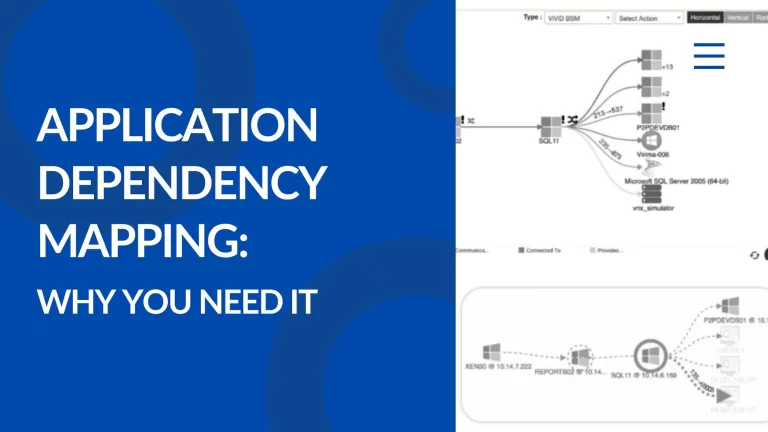
[VISUAL: ViVID™ service map showing a multi-tier web application. An incident badge sits on a database CI. A change record badge appears on an upstream application server. An NVD vulnerability overlay marks a network device in the dependency chain. Ownership pop-up visible on the failing CI showing team name and contact.]
The ServiceNow CMDB receives enriched CI data from Virima through the bidirectional sync, improving CMDB accuracy alongside the ViVID map view.
| How does ViVID™ extend ServiceNow service mapping?ViVID™ extends ServiceNow service mapping by overlaying live ITSM data (open incidents, recent and pending changes) and NVD vulnerability intelligence directly on service dependency maps. It also surfaces CI ownership context on every node. ViVID integrates with ServiceNow through a no-code, bidirectional connection and keeps maps current through high-frequency discovery cycles rather than manual updates. |
Blast radius context before a change fires
This is where ViVID and ServiceNow service mapping together pay off most in change management. Before a change window opens, the change approver pulls up the ViVID service map for the CI being modified and sees:
- Every downstream service that CI supports
- Whether any dependent CI has an open incident
- What changes have recently touched CIs in the same service path
- Who owns each affected component
That information exists in your CMDB, but it is rarely assembled into a single view before the change ticket is approved. ViVID surfaces it automatically, using the same discovery data that feeds your ServiceNow CMDB.
According to the EMA ServiceOps Report, organizations using integrated service visibility tools were able to identify upstream and downstream change impacts before the change window, reducing change-related incidents — a capability that requires accurate, live service maps updated by discovery, not by quarterly audits.
| How does service mapping help with change management in ServiceNow?Service mapping helps change management in ServiceNow by showing which business services and downstream CIs are affected by a proposed change. Augmenting ServiceNow service maps with live ITSM and discovery data — as ViVID does — adds blast radius context and conflict detection before the change window opens. Teams can see open incidents, recent changes, and CI ownership on the same map before approving. |
NVD vulnerability intelligence on your service maps
ViVID pulls CVE and CPE data from NIST’s National Vulnerability Database and overlays it on the affected CI nodes in the service map. A security engineer reviewing the map for a business-critical application can see, at a glance, which component in the dependency chain has a known exposure — without switching to a separate vulnerability management platform.
This matters for two reasons. First, it speeds up prioritization. A CVE on a database that backs a revenue-generating service is more urgent than the same CVE on a test server. The service context shows you which is which. Second, it connects vulnerability remediation to change management. The ViVID map shows change risk and vulnerability exposure together, so the team can plan a patch without breaking adjacent services.
ViVID’s NVD integration is not a replacement for a dedicated vulnerability management platform. It gives your ITSM and change management process the service context needed to prioritize and sequence remediation correctly. This is part of what Virima calls Trusted Runtime Truth — live, explainable data across assets, dependencies, vulnerabilities, ownership, and change history, all in one view.
Getting started with ViVID and ServiceNow service mapping
Connecting ViVID to ServiceNow does not require custom code. The integration uses a no-code connection that bidirectionally syncs CI data between Virima’s CMDB and ServiceNow. Once connected, Virima runs high-frequency IT discovery scans to keep the asset inventory current, and ViVID builds service maps from that data.
Service definitions — which assets make up each business service — need to be loaded into Virima before the service maps can be generated. You provide those definitions manually, by importing a spreadsheet, or through an integration like Lean IX. Once they are in, map generation and ongoing maintenance run automatically.
For teams already working through service mapping implementation or evaluating how to address service mapping challenges in their ServiceNow environment, the ViVID + ServiceNow combination covers the gap between accurate topology and live operational context.
Frequently Asked Questions
Does ViVID replace ServiceNow service mapping?
No. ViVID works alongside ServiceNow service mapping. It adds operational context — ITSM overlays, vulnerability data, blast radius visualization, ownership — that is not native to ServiceNow’s map view. The ServiceNow CMDB receives enriched CI data from Virima through a bidirectional sync, so both systems benefit.
How does ViVID keep service maps accurate over time?
ViVID builds service maps from Virima’s discovery data, which runs on high-frequency cycles. When infrastructure changes — a server is replaced, a cloud instance spins up, a network path shifts — discovery data updates first, and the service map reflects that change without manual intervention. Service definitions still need to be managed (adding a new business service requires a definition update), but the map itself stays current automatically.
What vulnerability data does ViVID surface on service maps?
ViVID pulls CVE and CPE data from NIST’s National Vulnerability Database and displays it as overlays on the affected CI nodes in the service map. This shows which specific components in a service dependency chain have known exposures, allowing security and operations teams to prioritize remediation by service impact rather than by severity score alone.
Does ViVID work with ITSM platforms other than ServiceNow?
Yes. ViVID integrates with ServiceNow, Jira Service Management, Ivanti, HaloITSM, and Xurrent. The ITSM incident and change overlays on service maps work with any connected ITSM platform, not only ServiceNow.
ServiceNow service mapping gives your team a foundation for understanding how infrastructure supports business services. ViVID builds on that foundation by adding the live operational context — incidents, changes, vulnerabilities, ownership — that turns a topology map into a decision-support tool your engineers can act on immediately. See how Trusted Runtime Truth powers every ViVID service map, or schedule a demo at virima.com/request-demo to see how ViVID extends your ServiceNow service mapping environment.