IT Discovery Across Your Full Estate — Agent-Based, Agentless, and API-Based

Trusted runtime truth starts with authoritative discovery. Change approvals, incident response, vulnerability prioritization, AI agent actions — all depend on knowing what actually exists in your environment. Stale inventories and outdated configuration records don’t just create noise. They create risk.

Virima IT Discovery addresses that risk through multi-source, multi-protocol scanning across on-premises, cloud, and virtual environments. Every discovered CI carries an attribute-level source record and a last-verified timestamp. When two discovery sources disagree, Virima resolves the conflict by rule — not by whoever scanned last. The result: a verified, explainable  CMDB record your ITSM workflows can trust.

What Virima Discovers

Virima IT Discovery covers your full IT environment —
physical, virtual, on-premises, cloud, and edge.

servers

Physical servers and workstations

(on-premises, edge, data center)

Virtual machines and containers

Virtual machines and containers

(VMware vCenter, Hyper-V, Kubernetes)

Cloud resources

Cloud resources


(AWS EC2, Azure VMs, VPCs, App Gateways, and more)

Network devices

Network devices


(routers, switches, firewalls, load balancers)

Storage systems

Storage systems


(SANs, NAS, storage controllers)

Databases and applications

Databases and applications

(installed software, running services, open ports)

Software and license footprint

Software and license footprint

(installed versions, usage data, license counts)

OT and IoT devices

OT and IoT devices


(where network-accessible and protocol-compatible)

For each discovered asset, Virima captures hundreds of hardware and software attributes: OS version, patch level, CPU, RAM, and disk configuration, serial numbers, network adapters, running processes, installed certificates, and the relationships between assets. Every captured attribute carries a source tag and a timestamp — so you can trace exactly which discovery method produced it and when it was last verified.

Three Discovery Methods

Agent-Based Discovery

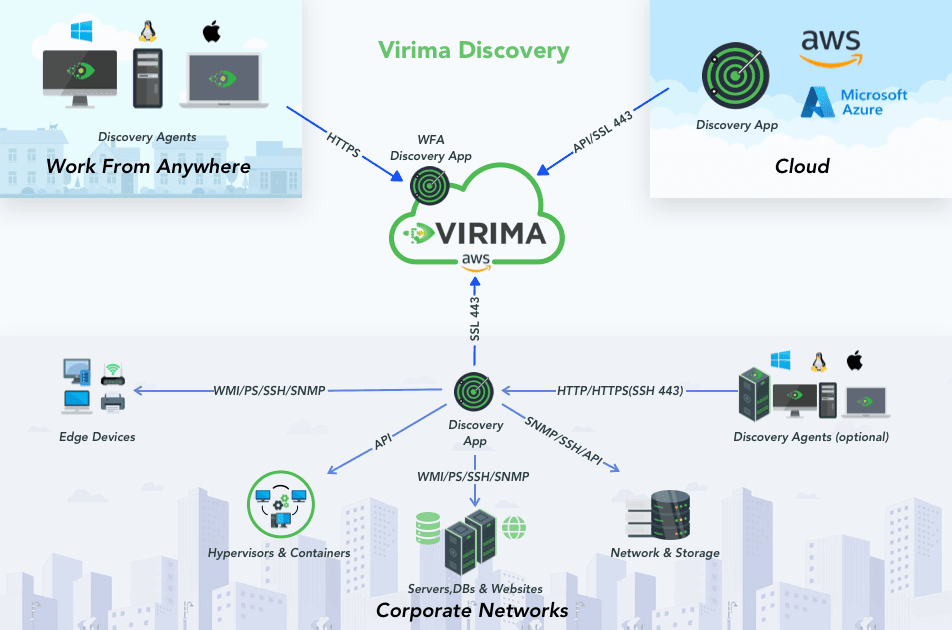
Virima deploys a lightweight agent on Windows, macOS, and Linux endpoints. The agent runs locally and captures configuration changes, software usage, and hardware state whether or not the device is connected to the corporate network. This matters for remote workers, roaming laptops, and endpoints in high-security environments where remote access credentials are restricted.

Use agent-based discovery when:
  • Endpoints frequently disconnect from the corporate network
  • Your security policy limits agentless credential access
  • You want software metering data to identify underused licenses
  • You need configuration monitoring for devices between scan cycles
Agents deploy directly from the Virima Discovery App or via software distribution tools like Microsoft SCCM. Agent versions update automatically — no manual maintenance on endpoints.

Agentless Discovery

Virima’s agentless scanning uses over 140 extendable probes across SNMP, WMI, SSH, and other protocols to discover and profile devices across your network — without installing anything on endpoints. You configure subnet ranges, provide credentials for the device types you want to scan, and schedule the scans. Virima handles the rest.
Agentless discovery covers:
  • On-premises servers, workstations, and data center infrastructure
  • Network devices, including VLAN and topology mapping
  • Storage systems (SAN, NAS)
  • Hypervisors and virtualization platforms (VMware, Hyper-V, Nutanix)
The Discovery App runs on a server you own and control — credentials stay local and never leave your environment.

API-Based Discovery

Virima pulls asset and configuration data from cloud APIs and third-party platforms directly.

API integrations cover:
  • Cloud hyperscalers — AWS and Azure (EC2, VPCs, App Gateways, Azure VMs)
  • Virtualization platforms — VMware vCenter, Microsoft Hyper-V
  • Event and alert management — SolarWinds, LogicMonitor, Nagios, and others
API-sourced data flows into the same multi-source reconciliation engine as agent and agentless data — so cloud and third-party CI records carry the same source tracking and conflict resolution rules as everything else in the CMDB.

See your environment like never before

Act faster, reduce risk, and operate with confidence.

Multi-Source Reconciliation

Conflict resolution by rule, not by timestamp

Most tools overwrite on last scan. Virima decides by authority — not recency. 

Virima

check blue

Authority rules determine which source wins for each attribute

check blue

Every CI traces back to its source, protocol, and timestamp

check blue

Conflicts resolved by rule — never silently overwritten

check blue

Explainable: you can see why any attribute has its current value

Other tools

No icon

Last scan wins — regardless of which source is more authoritative

No icon

No audit trail: no way to know where a CI value came from

No icon

Conflicting sources produce unpredictable records over time

No icon

Stale or wrong values accumulate with no way to surface them

The result: a record you can explain on a sales call, defend in an audit, and rely on during an incident. 

CMDB Auto-Population

Your CMDB, kept current by discovery

Every discovered CI flows automatically into the Virima CMDB — source tag, last-verified timestamp, and ownership data
included. No manual entry. No import scripts.

Each CI record includes:
  • Hardware and software inventory
  • Relationship data — what connects to what, and how
  • Change history — which attributes changed between scans
  • Ownership assignments based on discovery scope
  • Vulnerability flags from NIST NVD — included at no charge, prioritized by asset criticality via ViVID™

Security and Compliance

Security built into every discovery run

storage

Credentials stay local

The Discovery App runs on a server you own. Credentials are encrypted on-device and never transmitted externally.

Encrypted

Encrypted in transit

All discovery data transmits to Virima’s platform over encrypted channels. Nothing moves in plaintext.

RBAC

RBAC + full audit trail

Role-based access controls who can configure and run discovery. Every CI change is logged.

Downstream Integrations

One discovery run, every platform updated

Discovery data feeds the Virima platform and syncs to every connected ITSM tool — automatically, on every scan.

Virima Discovery

Arrow
Arrow down
Virima CMDB

Virima
CMDB

ViVID™ Service Maps

ViVID™ Service maps

Virima ITAM

Virima
ITAM

ITSM INTEGRATIONS

IT Discovery Best Practices​

Step 1 — Find the right IT discovery tool for your needs

The best IT discovery tools balance coverage, accuracy, and operational effort. Don’t let a small gap in visibility derail you from getting a trusted view of your IT estate. When evaluating tools, confirm: what you need to discover (hardware, OS, installed software, configuration details); how data is collected (agentless, agent-based, and/or API-based discovery); whether you have the right permissions/credentials for agentless discovery; when and where you’ll need agents (for remote, off-network, or work-from-home devices). If budget allows, prioritize tools that also deliver asset relationship discovery and application dependency mapping. With Virima Discovery, you can combine agentless and agent-based methods (plus integrations where needed) to improve completeness — while keeping discovery scalable and maintainable.

Step 2 — Start simple, then expand coverage

Begin with the environments that are easiest to discover and provide the fastest value — typically on-network Windows servers and desktops. This creates a baseline for your IT estate. Then expand to Linux/Unix servers, hypervisors, network infrastructure, storage, edge components, remote sites, cloud environments, and work-from-home endpoints. Discovery maturity happens over time. Align stakeholders early so asset visibility becomes a shared operational discipline, not a one-time project.

Step 3 — Scan often and vary the timing

For best results, run frequent and time-varied scans. Varying the schedules helps you discover devices that only appear at certain times — without disrupting operations. Run scans on a recurring cadence (not one-time sweeps), vary scan windows to improve coverage, and use discovery data to support workflows. To maximize value, your discovery tool must integrate with IT Asset Management (ITAM), IT Service Management (ITSM), IT Operations Management (ITOM), security tools, and finance/ERP systems.

Step 4 — Address exceptions and close the gaps

Once most assets are discovered and added to the CMDB, focus on remaining holdouts. Common reasons for discovery exceptions include insufficient credentials, missing device permissions, required tools not installed or reachable, or systems too busy during scan windows. The goal is to identify why an asset isn’t being discovered, then decide the best path forward. With Virima Discovery, exception details help teams diagnose issues faster.


Frequently Asked Questions

01. What is IT discovery?
IT discovery is the process of identifying what assets exist across a network and capturing detailed configuration data for each one — hardware specs, software inventory, OS versions, running services, patch levels, and the relationships between assets. Virima IT Discovery uses three methods — agent-based, agentless, and API-based collection — to maximize coverage across on-premises, cloud, and hybrid environments. Every discovered asset flows into the CMDB with source tracking and a last-verified timestamp attached, forming the verified estate record that connected teams depend on.
A powerful IT discovery tool like Virima IT Discovery will help you get complete visibility into your most valuable assets, including hardware, software, data center, edge, cloud, remote, and work-from-home assets. Other asset types you can expect from an IT discovery tool include virtual machines, containers, websites, and data storage.
IT discovery and IT asset management go hand in hand. A proper IT discovery tool helps you automatically discover all your IT assets across your IT environment, including license and configuration details.
Yes. With an intuitive IT discovery tool like Virima, you can identify and classify complete information about virtual machines and the hypervisors that manage them, such as VMware vCenter and Microsoft Hyper-V. Virima IT Discovery will tell you where the VM resides (physical server, AWS EC2 instance, Azure Virtual Machine), hardware configurations, operating system details, installed software, and relationships to other VMs and infrastructure components. It will also tell you what applications and services the virtual machine supports.
IT asset discovery makes it simple for you to know your assets inside out — what you have or don’t have, what you need, and what you need to dispose of. When done right, IT asset discovery helps you improve security and avoid penalties by keeping you aware of unlicensed software usage. IT discovery helps you understand your network architecture and identify vulnerabilities, keeps you aware of license status for your assets, simplifies IT asset tracking, and helps you make efficient and responsible financial decisions when it comes to IT assets.
Selecting an IT discovery tool that’s compatible with your existing infrastructure is crucial. While choosing an IT discovery tool, make sure it can integrate with your existing infrastructure. For instance, Virima IT Discovery integrates with AWS and Azure, hypervisors, network and storage APIs, event and alert management, third-party ITSM platforms, and Virima CMDB, ITAM, and ITSM.
For IT cost optimization, you need to reduce expenses and spend on the right things. To optimize costs, you first need visibility into your IT assets — which is only possible through IT discovery. An IT discovery tool like Virima will help you gain transparency and a complete view of your assets. It also keeps you vigilant by continuously monitoring your IT environment so that waste doesn’t build up again. IT discovery also automates manual, error-prone tasks to reduce disruptions.

Virima IT Discovery is the source engine for your CMDB — delivering discovery-verified data that powers your configuration records, your ViVID™ service maps, and every team that needs to know what exists, how it connects, and what could break. 

Agentless discovery scans devices across the network using credentials and protocols like SNMP, WMI, and SSH — without installing anything on endpoints. It provides broad coverage across data center infrastructure and network devices. Agent-based discovery deploys a lightweight agent on individual endpoints, enabling local configuration monitoring even when devices disconnect from the corporate network. Agents are better for roaming laptops, remote workers, and high-security environments with credential restrictions. Virima supports both methods plus API-based collection, combining them for broader coverage and attribute-level reconciliation into a single governed CMDB record.
The Discovery agent can be pushed via the Discovery App to target machines or installed as a Windows MSI and pushed via software management tools such as SCCM. Once installed, agent versions are automatically kept up to date.
Virima’s agentless Discovery App scans subnets and IP ranges you configure, using over 140 probes across SNMP, WMI, SSH, and other protocols to profile network devices, servers, VMs, and connected infrastructure. The app runs on a Windows server within your environment and executes scans on a schedule you set. Virima also discovers network topology — VLAN membership, device connectivity, router and firewall relationships — and brings that into the CMDB as relationship data, feeding the dependency maps in ViVID™. Virima’s discovery engine is designed not to flood the network or impact device performance during scans.

Absolutely! With our API integration for ServiceNow you can have bi-directional synchronization between Virima Discovery and the ServiceNow CMDB. Virima’s ViVID™ Service Maps are viewable within either system.

Testimonials

What our customers are saying

Blue Quote icon
Bitmap
“With its ViVID interface and ASD, Virima uniquely combines machine-driven accuracy with human context — addressing critical visibility gaps no ITSM tool alone can solve.”

EMA Research

Blue Quote icon

Finally, a CMDB that Delivers on its Promise

“We use VIRIMA as our CMDB software to gather information from all our network devices such as servers, desktops, and laptops. The Discovery part of the software is very intuitive and works perfectly. We use it to manage and track assets.”

Christopher Rodriguez

IT Asset Manager in Healthcare and Biotech

Blue Quote icon

Visibility Auditors Trust

“Auditors demand clear evidence of data flow and system communications. With ViVID™, we have complete visibility into every connection, helping us strengthen business continuity, prioritize critical services, and deliver the transparency auditors value.”

Robert Hanson

IT Manager and Director
at a US-based Bank

Move faster. Act safely.

Virima IT Discovery delivers the verified, multi-source record that every team connected to the Virima platform
depends on — from change management to incident response to AI-driven automation.