How Good is Your IT Change Management Process?

In change management, “pretty good” can get you in big trouble. You have an established IT change management process, but is it always followed? Even when change requests go through proper approvals, undocumented deviations slip through. And those are the ones that cost you.
The loophole in every change process
Think about a web server upgrade or a database patch. Systems engineers often make a few tweaks on the fly and either forget to document them or skip it on purpose. Maybe they’re too busy to report small changes. Maybe the change advisory board (CAB) process feels like too much bureaucracy for a quick fix.
That undocumented tweak could break something else, and the failure might not show up for weeks. When it finally surfaces, the team reviews the change log. But the culprit isn’t in the documentation exposing a critical gap in your IT change management process.
Even if the original tweak was harmless, subsequent changes built on inaccurate records can fail. When they do, diagnosing the root cause is nearly impossible.
What is configuration drift and why does it matter?
Configuration drift happens when the actual state of a device no longer matches what’s documented. It’s the gap between what your records say and what’s really running in production. In configuration management terms, drift is the direct result of undocumented changes, and it’s one of the most common reasons change requests fail unexpectedly.
Left unchecked, drift compounds. Each undocumented tweak pushes your records further from reality. Your CAB reviews requests against a baseline that no longer exists, and your team loses confidence in the change process itself.
This is the core tension between change management configuration management — one depends entirely on the other: change management can only be as reliable as the CMDB data it draws from, and CMDB accuracy erodes the moment undocumented changes go undetected.
How does a CMDB support change management?
Your CMDB is the single source of truth for your IT environment — your assets, their configurations, and how systems connect. When a change request comes in, the CAB reviews it against the CMDB to understand what’s connected and what might break.
Without an accurate CMDB, change impact analysis is guesswork. An engineer proposes a server change, but nobody knows which applications depend on that server. Structured IT change impact analysis — knowing the full blast radius of a proposed change before the CAB votes on it — is what separates teams that approve changes confidently from those that find out what broke after the fact.
Virima’s automated discovery keeps the CMDB current by continuously scanning your environment across on-premises, cloud, and hybrid infrastructure. The data your CAB relies on reflects what’s actually deployed, not what was deployed six months ago.
How to close gaps in your IT change management process
What can you do to close this gap? Training helps, but “trust but verify” is the real answer. You need a tool that detects device-level configuration drift automatically, not one that depends on engineers self-reporting every change.
One area where this gap is especially costly is certificate management — SSL/TLS certificates are routinely updated, renewed, or replaced outside formal change workflows, and an expired or misconfigured certificate is exactly the kind of undocumented change that causes an outage no one saw coming.
How can you detect unauthorized or undocumented changes?
Virima’s automated discovery continuously scans your environment and detects configuration changes as they occur. When your ITSM platform processes a change request, Virima’s post-change discovery validates whether the environment matches the expected state — giving your team confidence that implementations happened as planned.
Because Virima maintains a complete configuration history with full audit trails and CI versioning, your team can quickly identify what changed and when. If something breaks, you’re not hunting through logs or guessing — you have a clear record of every configuration state to guide remediation.
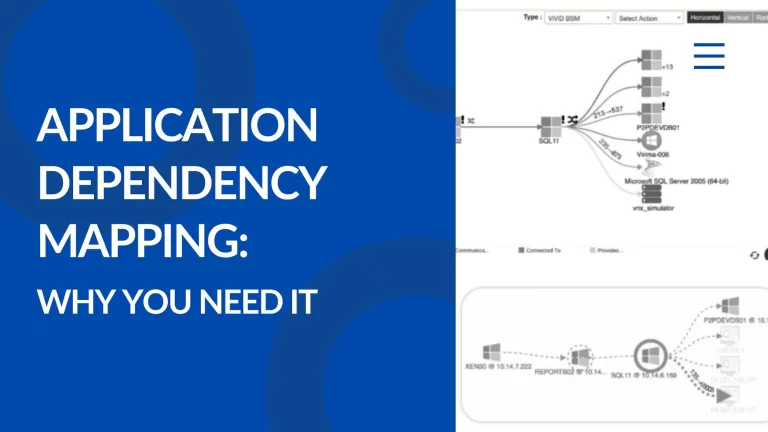
Virima’s ViVID™ service mapping also maps the dependencies between your IT resources, applications, and services. ViVID™ overlays pending and recent changes directly on the service map, so when a change is proposed, your CAB can see the full blast radius before approving it. And when something does go wrong, those same dependency maps help your team trace the impact and resolve incidents faster.
Virima integrates with the ITSM platforms where your change workflows already live, including ServiceNow, Jira Service Management, Ivanti, and HaloITSM, so you get this visibility without ripping out your existing processes.
Strengthen your change process with complete visibility
Proper change impact analysis starts with seeing your entire IT environment clearly. Virima’s combination of automated discovery, an always-accurate CMDB, and ViVID™ service mapping gives your IT change management process the foundation it needs.
Ready to close the gap? Contact us to schedule a demo.